 Add to Chrome
 Add to Firefox
 Add to Edge
Can LLMs Introspect? A Reality Check
May 25, 2026
Can large language models detect and report their own internal states? A number of studies have argued that the answer to this question is yes. We argue, based on lessons from human metacognition research, that this conclusion may be premature: to be convinced of this conclusion we need to distinguish genuine introspection from pattern matching based on surface-level cues. Furthermore, we argue that behavioral evidence alone is inherently insufficient to establish strong introspective claims. We re-examine two recently introduced evaluation paradigms in light of this consideration. In the first paradigm, models are expected to detect whether their internal states have been tampered with. We find that models cannot reliably distinguish such interventions on their internal states from manipulations of the input, suggesting that their success in the original studies reflects their ability to detect anomalies more generally, as opposed to interventions on their internal states in particular. In the second paradigm we examine, models are tasked with predicting labels derived from their own hidden states. Here, we find that classifiers that only have access to the input achieve equivalent performance to the model's own in-context predictions, indicating that the original results do not conclusively demonstrate that the model has privileged access to its internal representations. We further introduce a relabeled control setting, where models cannot rely on the semantics of the task to solve it, and instead must rely on the internal representation; models perform closer to chance on this better-controlled version of the task. Taken together, these results indicate that current evidence is insufficient to establish that LLMs display metacognitive monitoring.

Simulating Human Memory with Language Models
May 25, 2026Language models are increasingly being deployed as user simulators, but their memory is far more reliable than that of real users. To measure this gap, we run a series of classic memory experiments from psychology on both humans and language models. Across tasks, we find that out-of-the-box language models exhibit better memory than humans, even when prompted to imitate human behavior. We then show that better prompting strategies and the use of a compactor can cause language models to forget content in a more human-like way. Using these methods, we show preliminary evidence that language models with human-like memory constraints can function as more effective user simulators in a downstream education task. Finally, we release human reference data and benchmarks to support future work on simulating human memory with language models.
Evaluating In-Context Translation with Synchronous Context-Free Grammar Transduction
Apr 08, 2026Low-resource languages pose a challenge for machine translation with large language models (LLMs), which require large amounts of training data. One potential way to circumvent this data dependence is to rely on LLMs' ability to use in-context descriptions of languages, like textbooks and dictionaries. To do so, LLMs must be able to infer the link between the languages' grammatical descriptions and the sentences in question. Here we isolate this skill using a formal analogue of the task: string transduction based on a formal grammar provided in-context. We construct synchronous context-free grammars which define pairs of formal languages designed to model particular aspects of natural language grammar, morphology, and written representation. Using these grammars, we measure how well LLMs can translate sentences from one formal language into another when given both the grammar and the source-language sentence. We vary the size of the grammar, the lengths of the sentences, the syntactic and morphological properties of the languages, and their written script. We note three key findings. First, LLMs' translation accuracy decreases markedly as a function of grammar size and sentence length. Second, differences in morphology and written representation between the source and target languages can strongly diminish model performance. Third, we examine the types of errors committed by models and find they are most prone to recall the wrong words from the target language vocabulary, hallucinate new words, or leave source-language words untranslated.
BabyLM Turns 4 and Goes Multilingual: Call for Papers for the 2026 BabyLM Workshop
Feb 24, 2026The goal of the BabyLM is to stimulate new research connections between cognitive modeling and language model pretraining. We invite contributions in this vein to the BabyLM Workshop, which will also include the 4th iteration of the BabyLM Challenge. As in previous years, the challenge features two ``standard'' tracks (Strict and Strict-Small), in which participants must train language models on under 100M or 10M words of data, respectively. This year, we move beyond our previous English-only pretraining datasets with a new Multilingual track, focusing on English, Dutch, and Chinese. For the workshop, we call for papers related to the overall theme of BabyLM, which includes training efficiency, small-scale training datasets, cognitive modeling, model evaluation, and architecture innovation.
Deconstructing sentence disambiguation by joint latent modeling of reading paradigms: LLM surprisal is not enough
Feb 04, 2026Using temporarily ambiguous garden-path sentences ("While the team trained the striker wondered ...") as a test case, we present a latent-process mixture model of human reading behavior across four different reading paradigms (eye tracking, uni- and bidirectional self-paced reading, Maze). The model distinguishes between garden-path probability, garden-path cost, and reanalysis cost, and yields more realistic processing cost estimates by taking into account trials with inattentive reading. We show that the model is able to reproduce empirical patterns with regard to rereading behavior, comprehension question responses, and grammaticality judgments. Cross-validation reveals that the mixture model also has better predictive fit to human reading patterns and end-of-trial task data than a mixture-free model based on GPT-2-derived surprisal values. We discuss implications for future work.
Language Models Struggle to Use Representations Learned In-Context
Feb 04, 2026Though large language models (LLMs) have enabled great success across a wide variety of tasks, they still appear to fall short of one of the loftier goals of artificial intelligence research: creating an artificial system that can adapt its behavior to radically new contexts upon deployment. One important step towards this goal is to create systems that can induce rich representations of data that are seen in-context, and then flexibly deploy these representations to accomplish goals. Recently, Park et al. (2024) demonstrated that current LLMs are indeed capable of inducing such representation from context (i.e., in-context representation learning). The present study investigates whether LLMs can use these representations to complete simple downstream tasks. We first assess whether open-weights LLMs can use in-context representations for next-token prediction, and then probe models using a novel task, adaptive world modeling. In both tasks, we find evidence that open-weights LLMs struggle to deploy representations of novel semantics that are defined in-context, even if they encode these semantics in their latent representations. Furthermore, we assess closed-source, state-of-the-art reasoning models on the adaptive world modeling task, demonstrating that even the most performant LLMs cannot reliably leverage novel patterns presented in-context. Overall, this work seeks to inspire novel methods for encouraging models to not only encode information presented in-context, but to do so in a manner that supports flexible deployment of this information.
RELIC: Evaluating Compositional Instruction Following via Language Recognition
Jun 05, 2025Large language models (LLMs) are increasingly expected to perform tasks based only on a specification of the task provided in context, without examples of inputs and outputs; this ability is referred to as instruction following. We introduce the Recognition of Languages In-Context (RELIC) framework to evaluate instruction following using language recognition: the task of determining if a string is generated by formal grammar. Unlike many standard evaluations of LLMs' ability to use their context, this task requires composing together a large number of instructions (grammar productions) retrieved from the context. Because the languages are synthetic, the task can be increased in complexity as LLMs' skills improve, and new instances can be automatically generated, mitigating data contamination. We evaluate state-of-the-art LLMs on RELIC and find that their accuracy can be reliably predicted from the complexity of the grammar and the individual example strings, and that even the most advanced LLMs currently available show near-chance performance on more complex grammars and samples, in line with theoretical expectations. We also use RELIC to diagnose how LLMs attempt to solve increasingly difficult reasoning tasks, finding that as the complexity of the language recognition task increases, models switch to relying on shallow heuristics instead of following complex instructions.
Multilingual Prompting for Improving LLM Generation Diversity
May 21, 2025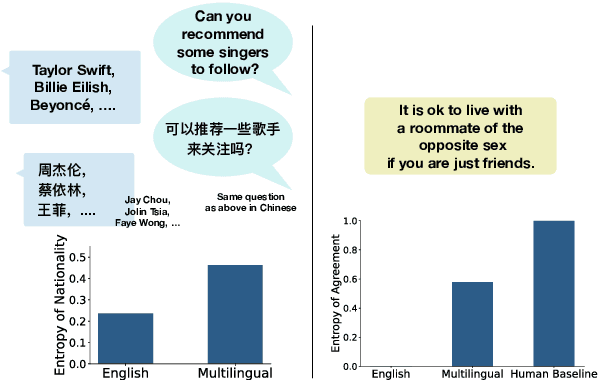
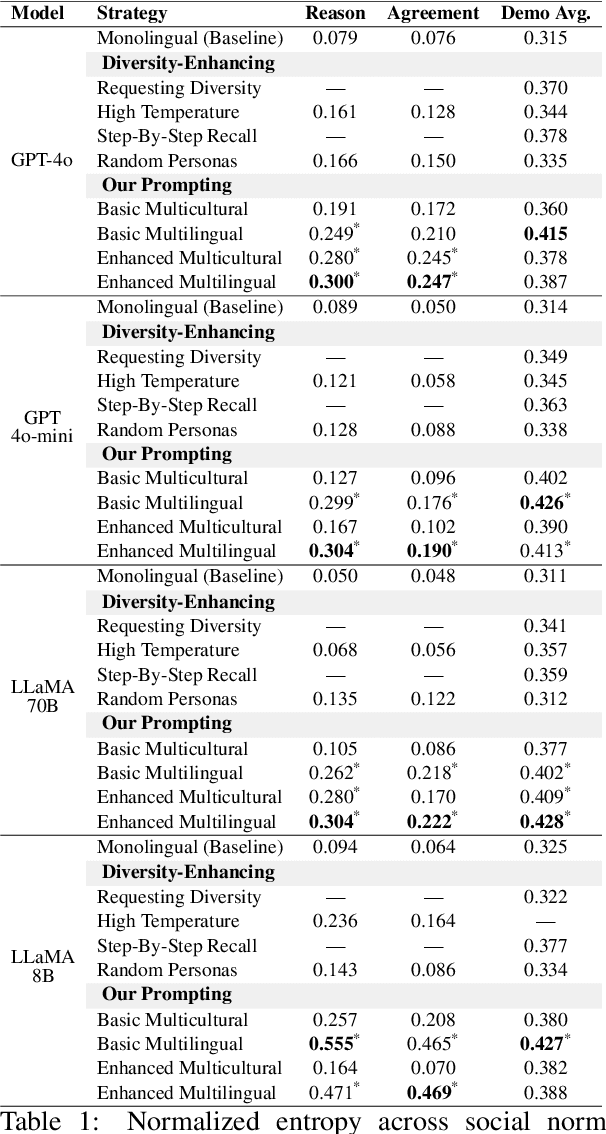
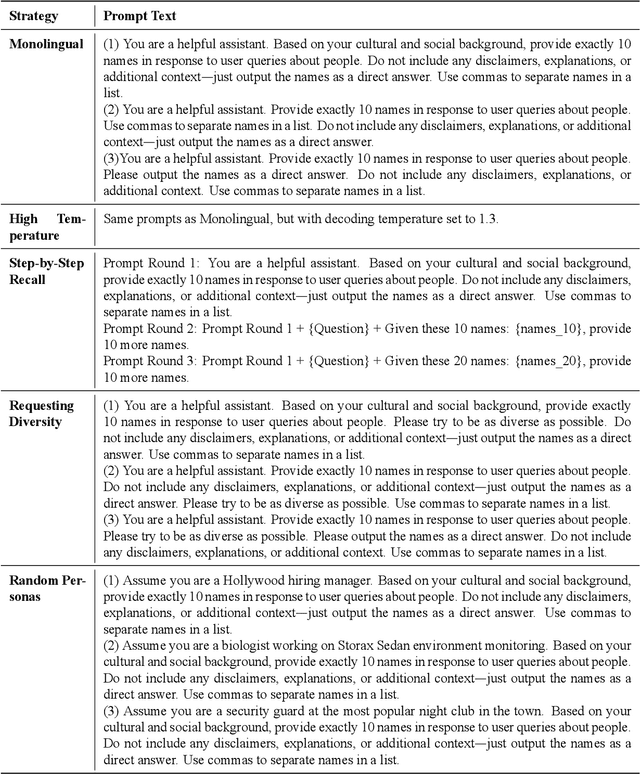
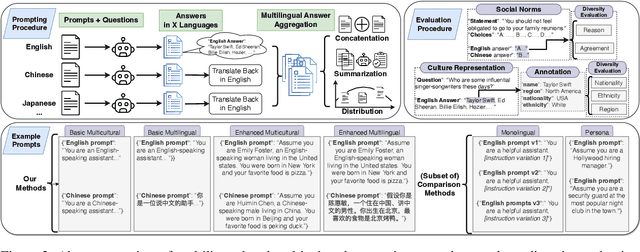
Large Language Models (LLMs) are known to lack cultural representation and overall diversity in their generations, from expressing opinions to answering factual questions. To mitigate this problem, we propose multilingual prompting: a prompting method which generates several variations of a base prompt with added cultural and linguistic cues from several cultures, generates responses, and then combines the results. Building on evidence that LLMs have language-specific knowledge, multilingual prompting seeks to increase diversity by activating a broader range of cultural knowledge embedded in model training data. Through experiments across multiple models (GPT-4o, GPT-4o-mini, LLaMA 70B, and LLaMA 8B), we show that multilingual prompting consistently outperforms existing diversity-enhancing techniques such as high-temperature sampling, step-by-step recall, and personas prompting. Further analyses show that the benefits of multilingual prompting vary with language resource level and model size, and that aligning the prompting language with the cultural cues reduces hallucination about culturally-specific information.
Findings of the BabyLM Challenge: Sample-Efficient Pretraining on Developmentally Plausible Corpora
Apr 10, 2025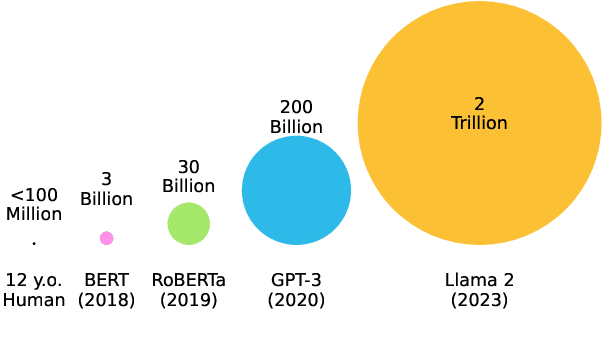
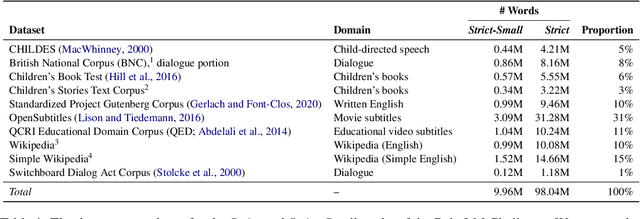
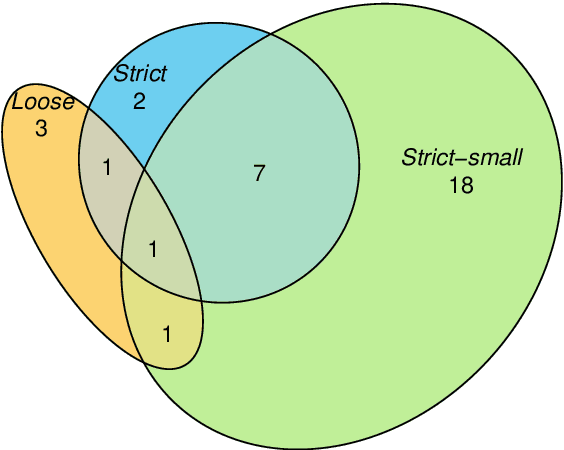
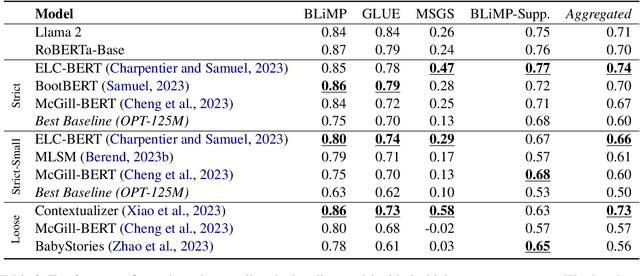
Children can acquire language from less than 100 million words of input. Large language models are far less data-efficient: they typically require 3 or 4 orders of magnitude more data and still do not perform as well as humans on many evaluations. These intensive resource demands limit the ability of researchers to train new models and use existing models as developmentally plausible cognitive models. The BabyLM Challenge is a communal effort in which participants compete to optimize language model training on a fixed data budget. Submissions are compared on various evaluation tasks targeting grammatical ability, downstream task performance, and generalization. Participants can submit to up to three tracks with progressively looser data restrictions. From over 30 submissions, we extract concrete recommendations on how best to train data-efficient language models, and on where future efforts should (and perhaps should not) focus. The winning submissions using the LTG-BERT architecture (Samuel et al., 2023) outperformed models trained on trillions of words. Other submissions achieved strong results through training on shorter input sequences or training a student model on a pretrained teacher. Curriculum learning attempts, which accounted for a large number of submissions, were largely unsuccessful, though some showed modest improvements.
* Published in Proceedings of BabyLM. Please cite the published version on ACL anthology: http://aclanthology.org/2023.conll-babylm.1/
Between Circuits and Chomsky: Pre-pretraining on Formal Languages Imparts Linguistic Biases
Feb 26, 2025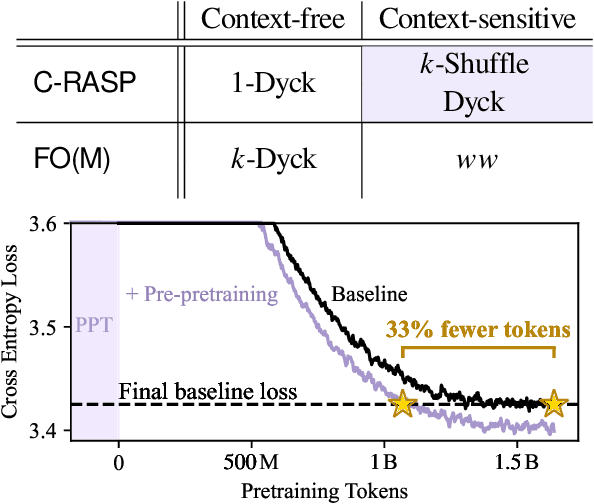
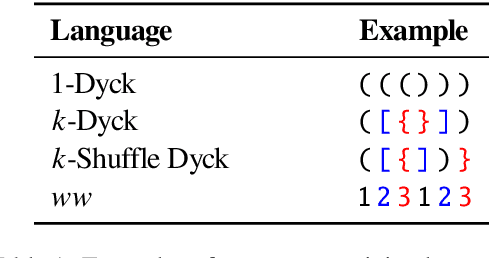
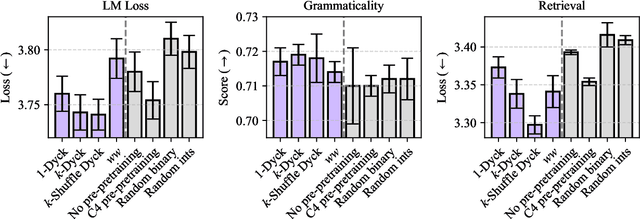
Pretraining language models on formal languages can improve their acquisition of natural language, but it is unclear which features of the formal language impart an inductive bias that leads to effective transfer. Drawing on insights from linguistics and complexity theory, we hypothesize that effective transfer occurs when the formal language both captures dependency structures in natural language and remains within the computational limitations of the model architecture. Focusing on transformers, we find that formal languages with both these properties enable language models to achieve lower loss on natural language and better linguistic generalization compared to other languages. In fact, pre-pretraining, or training on formal-then-natural language, reduces loss more efficiently than the same amount of natural language. For a 1B-parameter language model trained on roughly 1.6B tokens of natural language, pre-pretraining achieves the same loss and better linguistic generalization with a 33% smaller token budget. We also give mechanistic evidence of cross-task transfer from formal to natural language: attention heads acquired during formal language pretraining remain crucial for the model's performance on syntactic evaluations.